If I had ever harbored thoughts of a Hollywood career, my first blunder came early. Say, by age ten. Truthfully, that kid had no imagination for something so distant anyway, but even then, I was already tanking the first rule of show biz: always be working your contacts. People from your past or present might mean different things in the future. By some strange energy, the same is often true of places.
I had no reason to suspect that my next door neighbor (well, two doors down) — genial Dad to my after-school buddy, Den Leader to my short Cub Scout stint — would soon go on to become one of the great Hollywood casting directors (more on him in a bit). Nor would I, or anyone else, have imagined that one day they’d be regularly shooting major movies and TV shows in our rusting hometown of Paterson. Finally, I would have not believed that Hollywood itself – the industry, and even the art of cinema – owes a something of a debt to Paterson. Even part of its origin story.
The First Blockbuster
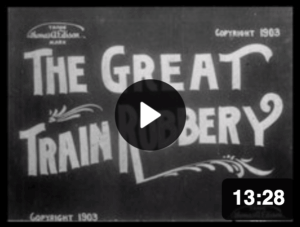
Long before full-length feature films, there was The Great Train Robbery. Shot – today, we’d say “directed” – in 1903 by Edwin Porter, an employee of the Edison Manufacturing Company, it was the first American film to win a mass audience. Movies at the time were mostly quick, one-reel affairs, with little or no editing or change in camera position. Porter introduced numerous cinematic innovations he’d seen from European pioneers like Georges Méliès. Most important among them was the idea that you could use film to tell a story.
The story of The Great Train Robbery is just what it says. There’s a train stickup, and good guys chase the bad guys on horseback before finally gunning them down. All this in less than fifteen minutes. What’s this got to do with Paterson?
Even then, it was a great location. Key scenes were shot in the valley below Garret Mountain, and if you were the NJ-based Edison Company and needed to shoot a train and train tracks, you couldn’t do better than Paterson, which hosted the Delaware, Lackawanna and Western Railroad lines. In fact, Silk City could just as well have been called Locomotive City; more than 10,000 were built there, including the west-bound engine that joined the Golden Spike.
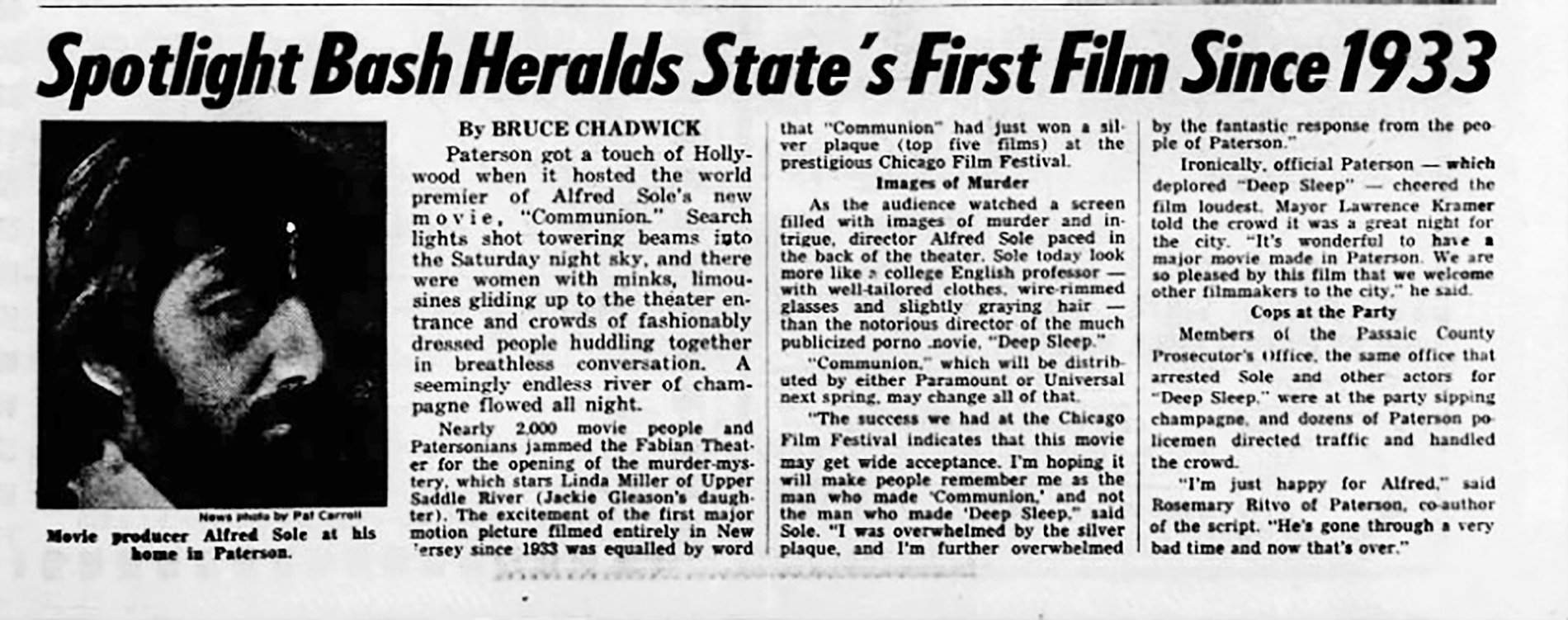
The fledgling motion picture industry, such as it was, soon moved out west. Good weather for outdoor shooting surely helped, but the main reason was to get as far away as possible from heavy-handed lawsuits (and worse) from the Edison Company. By 1911, the first Hollywood studio opened on Sunset Boulevard. The first modern film shot in New Jersey – Paterson, no less – that I ever heard of was Alfred Sole’s low-budget slasher flick Communion, later re-titled Alice, Sweet Alice, starring a pre-fame Brooke Shields. That was 1976; it was the first movie to be shot in the state since 1933.
Look at Them Now
In 2018, The Garden State Film and Digital Media Jobs Act began offering tax credits, and the cameras soon followed. A relative hop skip and jump from the New York production companies, Paterson started getting starring roles. Steven Spielberg and West Side Story; David Simon and The Plot Against America; Aaron Sorkin and The Trial of the Chicago 7; Jordan Peele and Hunters. The city’s many faces – urban, not-urban – and plentiful Beaux Arts architecture makes it very photogenic.
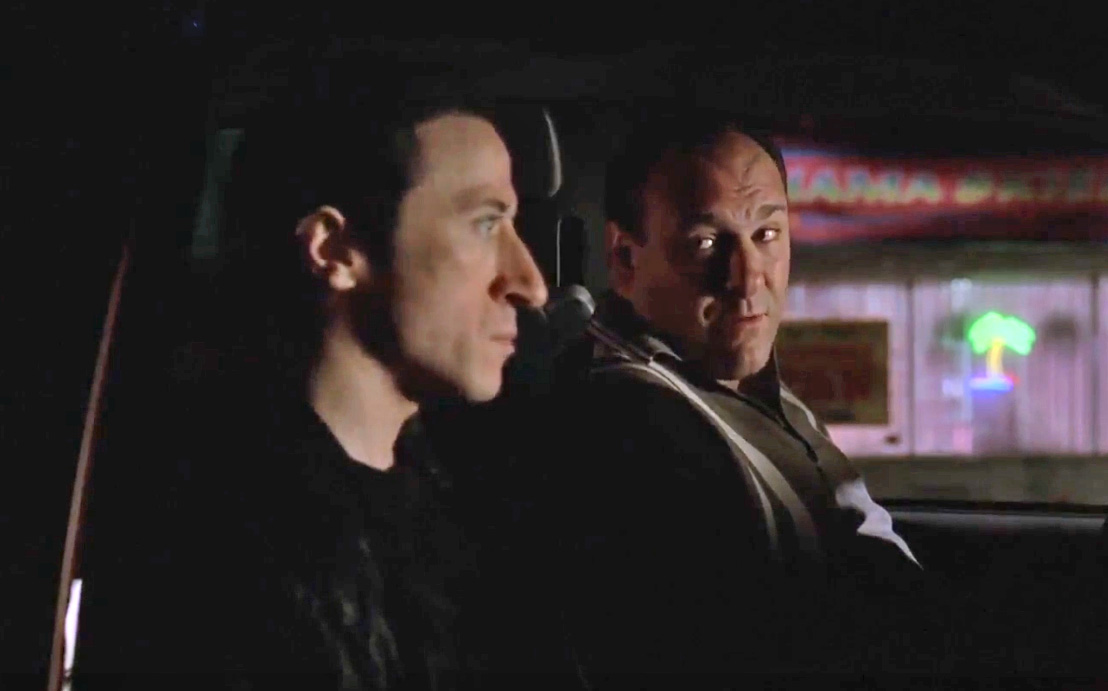
Two recent artists who’ve really captured some of the unique feel – dare I say soul – of the city, deserve special mention. David Chase, of course, who grew up next door in Clifton, paid many visual homages to Paterson in The Sopranos. In an early episode, someone gets tossed over the Great Falls, and you can bet local audiences shuddered more than most. Beyond the plentiful scenes shot in the old Italian enclave around Cianci Street, near what is now Lou Costello Park, he even cast a local boy as the fearsome Neapolitan enforcer, Furio Giunta. We can be certain that Patersonian Federico Castelluccio brought something to the audition that the other actors couldn’t.
Another artist who beautifully teases the soul (there, I said it) of the city is Jim Jarmusch, in his gem of cinema-as-poem, Paterson. I must admit that when I first heard of this project – a movie about a poet named Paterson, who’s also a bus driver in Paterson – my heart sank a bit. That said, I was completely surprised by this touching little film about creativity, love and perseverance. Among other things, it’s a deeply affectionate ode to the city, and to the poet William Carlos Williams, who immortalized the city. The brilliant cinematographer Frederick Elmes, another Jersey boy, makes Paterson look and feel like a magical place. When I bought the Blu-ray disc at Amoeba (in Hollywood!), the very pierced and tattooed cashier gushed when she saw the title. “It was so beautiful,” she sighed. “I’d so love to live there!”
A homage late in the game
So about the next-door casting mogul. Back in 1968, no one, not me, certainly, and maybe not even Louis DiGiaimo, could foresee the success he would go on to achieve. I was quite young, and we moved away the same year his new career began, but I remember him as a sunny guy, with a lovely wife who threw delightful birthday parties for their boys. Living in the house between his and ours was an older Italian woman straight out of central casting, who I assumed to be his immigrant mother. Spoke no English. A widow’s black dress every day. Grew vegetables, I think, in the back yard. Always a cheerful greeting and something unintelligible (to me, at least) in Italian. Mr. DiGiaimo was working as an accountant, and then did casting for a commercial advertising firm. Nothing about any of this hinted at Tinseltown.
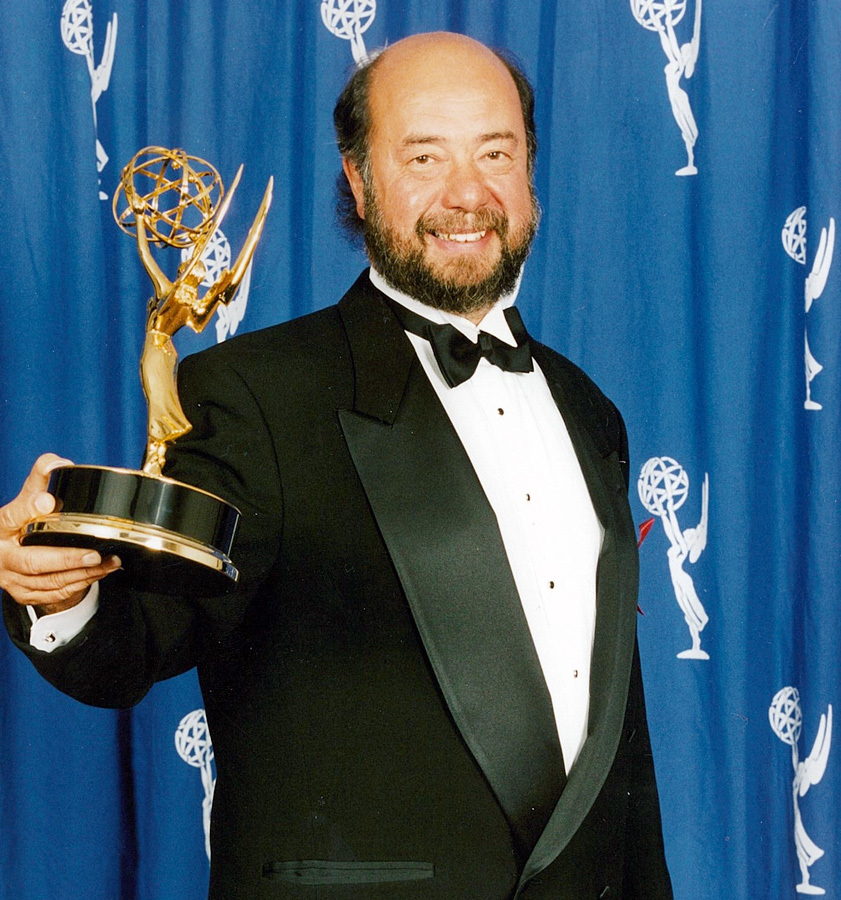
In the 1960s, while he was at the ad agency, the city of New York set up an office to facilitate filming in the five boroughs. Hearing of this, he managed to get a meeting with director Martin Ritt, who was prepping a gangster picture called The Brotherhood, starring Kirk Douglas. DiGiaimo not only suggested actors he thought would be good for the film, but he trawled the New York docks photographing non-actors that he thought would give the production authenticity. Ritt was impressed and hired him. The rest was history.
The Brotherhood bombed, but DiGiaimo’s next Mafia picture, four years later, did not – The Godfather. By then, he had already cast the Oscar-winning The French Connection, and would soon go on to cast classics like The Exorcist, Rain Man, Gladiator and Thelma and Louise, among many others. In this last film, it was DiGiaimo who championed a mostly unknown Brad Pitt for his breakout role, launching one of Hollywood’s biggest stars.
You can bet that Brad Pitt has not forgotten Louis DiGiaimo, who passed away in 2015. And while I lost the connection a lifetime before I moved to Hollywood (ok, West Hollywood), neither have I.
# # #
P.S. In 2026, the Academy of Motion Picture Arts & Sciences will award the first Oscar for Best Achievement in Casting. This category is long overdue for recognition and honors. Here’s hoping that one day soon there’s a special acknowledgement of Mr.DiGiaimo’s enduring contributions.